Página principal de la SEAP

  Información  ||  Congresos  ||  Cursos  ||  Territoriales  ||  Noticias  ||  Telepatología  


Presentación
Dificultades Dg.Histológico
 I. Hiperplasia/Neoplasia
    - Diferencias histológicas
    - Dif. Inmunohistoquím.
    - Diferencias Moleculares
    - Diferencias Biológicas
 II. Cambio aprocino
III. Diagnóstico de CDIS
IV.  ¿Ca. ductal o lobulillar?
 V.  Cicatriz Radial
VI.  Lesiones mioepiteliales
VII. Lesiones miofibroblást.
Her-2 en Carcinoma Mama
Prognostic Factors
  Macroscopic Examination 
  Traditional Factors
  Hormone Receptors
  Molecular Markers
  Patient Management 

Portada 2ª Reunión Dako
[Portada]

.

Dako. Su Referencia en Inmunohistoquímica

2ª Reunión Científica Dako

AVANCES EN PATOLOGÍA MAMARIA

17 de Mayo, 2000

[ Presentación ] [ Dg. Histológico ] [ Her-2 ] [ Prognostic Factors ]


II-TRADITIONAL MORPHOLOGICAL FACTORS


Introduction

Until relatively recently the main role of the diagnostic histopathologist lay in the establishment of a diagnosis of breast cancer from excision biopsy or frozen section. Apart from the examination of loco-regional lymph nodes for the presence or absence of metastases it was unusual for any other prognostic information to be supplied, or indeed requested. The treatment of breast cancer was standardised, predominantly surgical and there was little attempt to stratify patients for appropriate therapy on an individual basis. However, as mentioned previously, in the last two decades the treatment of breast cancer has undergone dramatic changes and a much wider range of both local and systemic therapeutic options is now available. Early diagnosis, especially since the advent of mammographic breast screening, is detecting tumours which are likely to have a favourable outcome and it has become extremely important to assess prognosis for each patient before a therapeutic plan is agreed.

A considerable amount of useful prognostic information is available from the careful histopathological examination of routine breast carcinoma specimens.1-Galea MH, Blamey RW, Elston CW, et al. The Nottingham Prognostic Index in primary breast cancer. Br Cancer Res Treat 1992; 22: 207-219. The following factors, all relatively simple to assess, have been shown to provide clinically relevant prognostic information, provided that careful attention is paid to diagnostic guidelines and protocols.

Tumour Size

For correlation with prognosis the size of tumours should only be assessed on pathological specimens, as clinical measurement is notoriously inaccurate. If an estimate of clinical tumour size is required for therapeutic planning purposes it should be checked by an ultrasonic measurement.

We recommend that the tumour diameter is measured in three planes to the nearest millimetre, initially in the fresh state. These measurements are then re-checked after fixation and the greatest diameter is taken as the tumour size. If there is any doubt about the size measurement tumour extent should be checked on histological sections using the stage micrometer. This is particularly appropriate for small tumours, especially those measuring 1 cm or less, and for tumours with a large in-situ component. Examples of the measurement of tumour size in a variety of circumstances are given in Fig 2.1.

As a time dependent factor tumour size has been shown consistently in many studies to influence prognosis, 2-Cutler SJ, Black MM, Mork T, et al. Further observations on prognostic factors in cancer of the female breast. Cancer 1969; 24: 653-657. // 3-Elston CW, Gresham GA, Rao GS, et al. The Cancer Research Campaign (Kings/Cambridge) trial for early breast cancer - pathological aspects. Brit J Cancer 1982; 45: 655-669. // 4-Fisher ER, Sass R, Fisher B, et al. Pathologic findings from the National Surgical Adjuvant Project for breast cancer (protocol no 4).  Discrimination for tenth year treatment failure. Cancer 1984; 53: 712-723. // 5-Carter GL, Allen C, Henson DE. Relation of tumour size, lymph node status, and survival in 24,740 breast cancer cases. Cancer 1989; 63: 181-187. // 6-Neville AM, Bettelheim R, Gelber RD, et al. Predicting treatment responsiveness and prognosis in node-negative breast cancer. J Clin Oncol 1992; 10: 696-705. patients with smaller tumours having a better long term survival than those with larger tumours. The significant correlations found by Elston et al, 3-Elston CW, Gresham GA, Rao GS, et al. The Cancer Research Campaign (Kings/Cambridge) trial for early breast cancer - pathological aspects. Brit J Cancer 1982; 45: 655-669. Fisher et al 4-Fisher ER, Sass R, Fisher B, et al. Pathologic findings from the National Surgical Adjuvant Project for breast cancer (protocol no 4).  Discrimination for tenth year treatment failure. Cancer 1984; 53: 712-723. and Neville et al 6-Neville AM, Bettelheim R, Gelber RD, et al. Predicting treatment responsiveness and prognosis in node-negative breast cancer. J Clin Oncol 1992; 10: 696-705. are of particular interest since the initial pathological assessments in these large multicentre trials, including measurement of tumours size, were all carried out by local participating pathologists rather than central pathologists. This emphasises the inherent strength of tumour size as a prognostic factor.
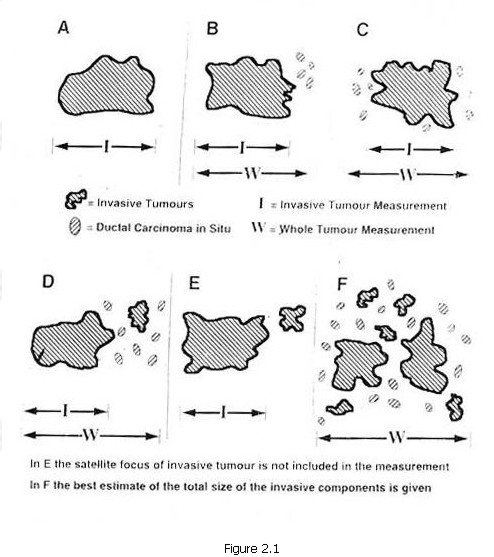
 

Figure 2.1

The estimation of tumour size has assumed particular importance in breast screening. The term 'minimal breast cancer' (MBC) was originally introduced to delineate certain forms of breast cancer which carried an exceedingly good prognosis.7-Gallager HS, Martin JE. An orientation to the concept of minimal carcinoma. Cancer 1971; 28: 1505-1507. MBC included all cases of in situ carcinoma (ductal and lobular) and invasive carcinomas measuring 5 mm or less. Subsequently, for no clearly defined reason the invasive component has been re-defined by various different groups. The Breast Cancer Detection Demonstration Projects 8-Beahrs OH, Shapiro S, Smart C, et al. Summary report of the Working Group to review the National Cancer Institute-American Cancer Society Breast Cancer Demonstration Detection Projects. J Nat Cancer Inst 1979; 62: 641-709. and the American Cancer Society 9-Hartman WH. Minimal breast cancer: an update. Cancer 1984; 53: 681-684. have used 9 mm or less as the maximum diameter, whilst the American College of Surgeons 10-Bedwani R, Vana J, Rosner D, et al. Management and survival of female patients with 'minimal' breast cancer: as observed in the long-term and short-term surveys of the American College of Surgeons. Cancer 1981; 47: 2769-2778. favour up to and including 10 mm.

This lack of uniformity in definition causes problems in the interpretation of data from different studies, but there is little doubt that minimal invasive carcinomas (MIC) are of an earlier stage than tumours which measure more than 10 mm in diameter. In most series the frequency of axillary lymph node metastasis in MIC is 15-20%, 5-Carter GL, Allen C, Henson DE. Relation of tumour size, lymph node status, and survival in 24,740 breast cancer cases. Cancer 1989; 63: 181-187. // 10-Bedwani R, Vana J, Rosner D, et al. Management and survival of female patients with 'minimal' breast cancer: as observed in the long-term and short-term surveys of the American College of Surgeons. Cancer 1981; 47: 2769-2778. // 11-Rosen PP, Groshen S. Factors influencing survival and prognosis in early breast carcinoma (T1N0M0-T1N1M0).  Assessment of 644 patients with median follow up of 19 years. Surg Clin North Am 1990; 70: 937-962. compared with over 40% in tumours measuring 15 mm or more. 11-Rosen PP, Groshen S. Factors influencing survival and prognosis in early breast carcinoma (T1N0M0-T1N1M0).  Assessment of 644 patients with median follow up of 19 years. Surg Clin North Am 1990; 70: 937-962. Even more favourable results are obtained in women with breast cancer detected during the prevalent round of breast screening, axillary node metastasis ranging from 0-15%.8-Beahrs OH, Shapiro S, Smart C, et al. Summary report of the Working Group to review the National Cancer Institute-American Cancer Society Breast Cancer Demonstration Detection Projects. J Nat Cancer Inst 1979; 62: 641-709. // 12-Gibbs NM. Comparative study of the histopathology of breast cancer in a screened and unscreened population investigated by mammography. Histopathol 1985; 9: 1307-1318. // 13-Tabar L, Duffy SW, Krusemo UB. Detection method, tumour size and node metastases in breast cancers diagnosed during a trial of breast cancer screening. Eur J Cancer Clin Oncol 1987; 23: 959-962. // 14-Frisell J, Eklund G, Hellstrom L, Somell A. Analysis of interval breast carcinomas in a randomized screening trial in Stockholm. Br Cancer Res Treat 1987; 17: 219-225. // 15-Anderson TJ, Lamb J, Donnan P, et al. Comparative pathology of breast cancer in a randomized trial of screening. Brit J Cancer 1991; 64: 108-113.

Surprisingly it is difficult to obtain accurate data on the relationship between MIC and prognosis but, as expected, survival appears to be better than for patients with larger tumours. For example, in the long term study from the Memorial-Sloan Kettering Cancer Centre 11-Rosen PP, Groshen S. Factors influencing survival and prognosis in early breast carcinoma (T1N0M0-T1N1M0).  Assessment of 644 patients with median follow up of 19 years. Surg Clin North Am 1990; 70: 937-962. the projected relapse-free survival rates 20 years after initial treatment were as follows:


<10 m - 88%

11-13 mm - 73%

14-16 mm - 65%

17 - 22 mm - 59%

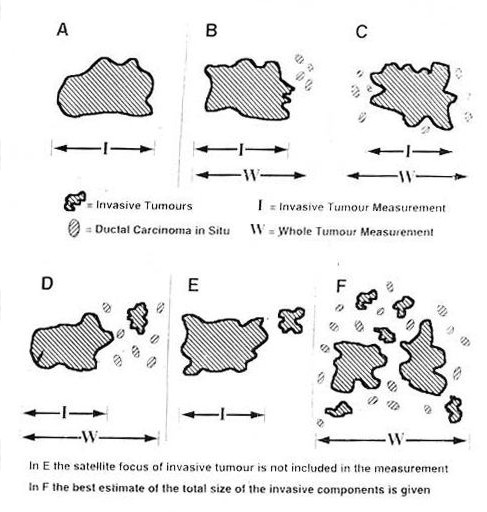
However, our own studies from the Nottingham Tenovus Primary Breast Cancer Study (NTPBCS) suggest that the cut of point of 10 mm is not necessarily the best discriminator for MIC (Fig 2.2). Life table analysis shows that the more significant size is 15 mm. The majority of the patients in this study are from symptomatic practice and it will be important to ascertain whether screening-detected tumours have the same pattern of prognosis.

It is clear, therefore, that tumour size is a valuable prognostic factor, and it has also become an important quality assurance measure for breast screening programmes, 9-Hartman WH. Minimal breast cancer: an update. Cancer 1984; 53: 681-684. // 13-Tabar L, Duffy SW, Krusemo UB. Detection method, tumour size and node metastases in breast cancers diagnosed during a trial of breast cancer screening. Eur J Cancer Clin Oncol 1987; 23: 959-962. // 16-Royal College of Radiologists. Quality Assurance Guidelines for Radiologists. NHS BSP Publications, No 15. 1997; used in part to judge the ability of radiologists to detect impalpable invasive carcinomas on mammography. For example, in the United Kingdom National Health Service Breast Screening Programme (NHSBSP) it is required of radiologists that 50% of the invasive cancers detected must measure less than 15 mm.16-Royal College of Radiologists. Quality Assurance Guidelines for Radiologists. NHS BSP Publications, No 15. 1997; It is, therefore, incumbent upon pathologists to measure tumour diameter as accurately as possible. As size decreases so the risk of errors in measurement increases, and marked inconsistencies have been reported. 8-Beahrs OH, Shapiro S, Smart C, et al. Summary report of the Working Group to review the National Cancer Institute-American Cancer Society Breast Cancer Demonstration Detection Projects. J Nat Cancer Inst 1979; 62: 641-709. // 17-Sloane JP, National Coordinating Group for Breast Screening Pathology. Consistency of histopathological reporting of breast lesions detected by screening: findings of the UK National External Quality Assessment (EQA) Scheme. Eur J Cancer 1994; 30A: 1414-1419.


Figure 2.2 Relationship between pathological tumour size and survival in 1763 patients with primary operable breast cancer.
Differentiation

Until comparatively recently, the histological classification of carcinoma of the breast was restricted to a main sub division into in situ and invasive carcinoma. The majority of invasive carcinomas were designated simply as scirrhous adenocarcinomas. It is now recognised that invasive carcinomas may be further sub divided morphologically according to their degree of differentiation. This is achieved in two ways, by assessing histological type and histological grade.

Histological Type

It is now accepted that a wide range of morphological patterns may be recognised in invasive carcinoma of the breast 18-Fisher ER, Gregorio RM, Fisher B. The pathology of invasive breast cancer.  A syllabus derived from findings of the National Surgical Adjuvant Breast Cancer Project (protocol no 4). Cancer 1975; 36: 144-156. // 19-Azzopardi JG. Problems in breast pathology. vol London: WB Saunders, 1979. // 20-Page DL, Anderson TJ, Sakamoto G. Infiltrating carcinoma: major histological types. In: Page DL, Anderson TJ, eds.  Diagnostic histopathology of the breast. London: WB Saunders, 1987: vol, 193-235. // 21-Ellis IO, Elston CW. Tumors of the breast. In: Fletcher CDM, ed.  Diagnostic Histopathology of Tumors. Churchill Livingstone, 1995: vol,  635-689. and that histological type provides useful prognostic information.20-Page DL, Anderson TJ, Sakamoto G. Infiltrating carcinoma: major histological types. In: Page DL, Anderson TJ, eds.  Diagnostic histopathology of the breast. London: WB Saunders, 1987: vol, 193-235. // 22-Ellis IO, Galea M, Broughton N, et al. Pathological prognostic factors in breast cancer. II.  Histological type.  Relationship with survival in a large study with long-term follow-up. Histopathol 1992; 20: 479-489.

The diagnostic criteria have been described in some detail previously 20-Page DL, Anderson TJ, Sakamoto G. Infiltrating carcinoma: major histological types. In: Page DL, Anderson TJ, eds.  Diagnostic histopathology of the breast. London: WB Saunders, 1987: vol, 193-235. // 22-Ellis IO, Galea M, Broughton N, et al. Pathological prognostic factors in breast cancer. II.  Histological type.  Relationship with survival in a large study with long-term follow-up. Histopathol 1992; 20: 479-489. // 23-National Co-ordinating Group for Breast Screening Pathology. Pathology Reporting in Breast Cancer Screening. 2nd ed ed; vol NHS BSP Publications No 3, 1995. // 24-Rosen PP. Rosen's Breast Pathology. vol Philadelphia: Lippincott-Raven, 1997. // 25-Elston CW, Ellis IO. The Breast. 3 ed; vol London: Churchill Livingstone, 1998. (Elston CW, Ellis IO, eds. Systemic Pathology.). and will not be repeated here. However, it must be appreciated that a considerable subjective element remains and there is not yet universal agreement for all types. This is reflected in the relative proportions of different types in published series (Table 2.1). Furthermore, in the NHSBSP pathology quality assurance scheme consistency of diagnosis of histological type was disappointingly low,17 implying that pathologists need to work to agreed diagnostic protocols.

The favourable prognosis of certain histological types of invasive carcinoma of the breast is well established. Thus tubular carcinoma, 26.	McDivitt RW, Boyce W, Gersell D. Tubular carcinoma of the breast. Am J Surg Pathol 1982; 6: 401-411. // 27-Cooper HS, Patchefsky AS, Krall RA. Tubular carcinoma of the breast. Cancer 1978; 42: 2334-2342. // 28-Carstens PHB, Greenberg RA, Francis D, Lyon H. Tubular carcinoma of the breast. A long-term follow-up. Histopathol 1985; 9: 271-280. mucinous carcinoma, 29-Lee BJ, Hauser H, Pack GT. Gelatinous carcinoma of the breast. Surg Gynecol Obstet 1934; 59: 841-850. // 30-Clayton F. Pure mucinous carcinomas of the breast: morphologic features and prognostic correlates. Hum Pathol 1986; 17: 34-38. invasive cribriform carcinoma, 31-Page DL, Dixon JM, Anderson TJ, et al. Invasive cribriform carcinoma of the breast. Histopathol 1983; 7: 525-536. medullary carcinoma, 32-Bloom HJC, Richardson WW, Field JR. Host resistance and survival in carcinoma of the breast: a study of 104 cases of medullary carcinoma in a series of 1411 cases of beast cancer followed for 20 years. Brit Med J 1970; 3: 181-188. // 33-Ridolfi RL, Rosen PP, Port A, et al. Medullary carcinoma of the breast - a clinicopathologic study with a ten year follow-up. Cancer 1977; 40: 1365-1385. infiltrating lobular carcinoma 34-Haagensen CD, Lane N, Lattes R, Bodian C. Lobular neoplasia (so-called lobular carcinoma in situ) of the breast. Cancer 1978; 42: 737-767. and tubulolobular carcinoma 35-Fisher ER, Gregorio RM, Redmond C, et al. Tubulolobular invasive breast cancer: A variant of lobular invasive cancer. Hum Pathol 1977; 8: 679-683. have all been reported to have a more favourable prognosis than invasive carcinomas of no specific type (ductal NST). Very few comprehensive long term follow up studies, relating histological type to survival, have been carried out. Dawson and colleagues 36-Dawson PJ, Ferguson DJ, Karrison T. The pathologic findings of breast cancer in patients surviving 25 years after radical mastectomy. Cancer 1982; 50: 2131-2138. found a relative excess of tubular, mucinous, medullary and infiltrating lobular carcinomas in patients who had survived at least 25 years after mastectomy, compared with those having a survival of less than 10 years. These findings were confirmed in a similar study from Edinburgh 37-Dixon JM, Page DL, Anderson TJ, et al. Long term survivors after breast cancer. Brit J Surg 1985; 72: 445-448. with the addition of papillary and invasive cribriform carcinomas amongst the long term survivors. The Edinburgh group have also found a relative excess of these 'special type' or 'specific type' tumours in cases of invasive carcinoma detected in the prevalent round of mammographic breast screening, 15-Anderson TJ, Lamb J, Donnan P, et al. Comparative pathology of breast cancer in a randomized trial of screening. Brit J Cancer 1991; 64: 108-113. and this has been confirmed in our own studies. 38-Ellis IO, Galea MH, Locker A, et al. Early experience in breast cancer screening: Emphasis on development of protocols for triple assessment. Breast 1993; 2: 148-153.

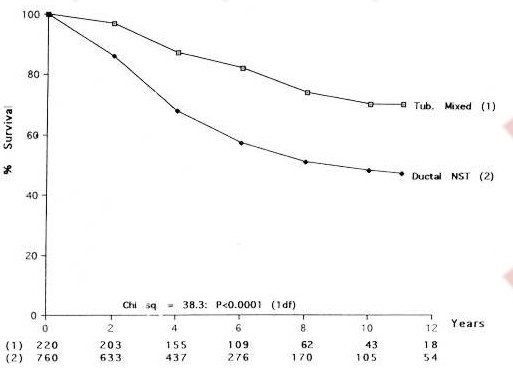
We have obtained further objective evidence that histological type can provide powerful prognostic information from the NTPBCS. 22-Ellis IO, Galea M, Broughton N, et al. Pathological prognostic factors in breast cancer. II.  Histological type.  Relationship with survival in a large study with long-term follow-up. Histopathol 1992; 20: 479-489. In a series comprising over 1500 patients with primary operable invasive carcinoma followed up for a minimum of 10 years the excellent prognosis of the special types, pure tubular, invasive cribriform and mucinous was confirmed (Fig 2.3). The study also showed that the categories of tubular mixed carcinoma and mixed ductal NST and special type are worth recording, since they carry a good prognosis, considerably better than ductal NST carcinoma (Fig 2.4). In previous studies such mixed types were rarely recognised and the tumours included within the general category of ductal NST. Since they account for at least 15 per cent of cases in a symptomatic series, valuable prognostic information is lost if they are overlooked.

It has become accepted dogma that medullary carcinoma carries an excellent or good prognosis.32-Bloom HJC, Richardson WW, Field JR. Host resistance and survival in carcinoma of the breast: a study of 104 cases of medullary carcinoma in a series of 1411 cases of beast cancer followed for 20 years. Brit Med J 1970; 3: 181-188. // 33-Ridolfi RL, Rosen PP, Port A, et al. Medullary carcinoma of the breast - a clinicopathologic study with a ten year follow-up. Cancer 1977; 40: 1365-1385. // 39-Moore Jr OS, Foote Jr FW. The relatively favourable prognosis of medullary carcinoma of the breast. Cancer 1949; 2: 635-642. // 40-Richardson WW. Medullary carcinoma of the breast.  A distinctive tumour type with a relatively good prognosis following radical mastectomy. Br J Cancer 1956; 10: 415-423. // 41-Rapin V, Contesso G, Mouriesse H, et al. Medullary breast carcinoma. A re-evaluation of 95 cases of breast carcinoma with inflammatory stroma. Cancer 1988; 61: 2503-2510. // 42-Lidang-Jensen M, Kiaer H, Andersen J, et al. Prognostic comparison of three classifications for medullary carcinomas of the breast. Histopathol 1997; 30: 523-532. It is interesting that this view has persisted despite the fact the other studies have been unable to confirm a survival advantage for medullary carcinoma compared with ductal NST carcinomas. 22-Ellis IO, Galea M, Broughton N, et al. Pathological prognostic factors in breast cancer. II.  Histological type.  Relationship with survival in a large study with long-term follow-up. Histopathol 1992; 20: 479-489. // 43-Cutler SJ, Black MM, Fried GH, et al. Prognostic factors in cancer of the female breast II.  Reproducibility of histopathologic classification. Cancer 1966; 19: 75-82. // 44-Pedersen L, Holck S, Schidt T. Medullary carcinoma of the breast. Cancer Treat Rev 1988; 15: 53-63. // 45-Fisher ER, Kenny JP, Sass R, et al. Medullary carcinoma of the breast revisited. Br Cancer Res Treat 1990; 16: 215-229. However, some of the latter studies have shown that medullary carcinoma does have a better prognosis than ductal NST carcinomas of grade 3. 22-Ellis IO, Galea M, Broughton N, et al. Pathological prognostic factors in breast cancer. II.  Histological type.  Relationship with survival in a large study with long-term follow-up. Histopathol 1992; 20: 479-489. // 44-Pedersen L, Holck S, Schidt T. Medullary carcinoma of the breast. Cancer Treat Rev 1988; 15: 53-63. // 45-Fisher ER, Kenny JP, Sass R, et al. Medullary carcinoma of the breast revisited. Br Cancer Res Treat 1990; 16: 215-229. Ellis and colleagues 22-Ellis IO, Galea M, Broughton N, et al. Pathological prognostic factors in breast cancer. II.  Histological type.  Relationship with survival in a large study with long-term follow-up. Histopathol 1992; 20: 479-489. have therefore concluded that medullary carcinoma should be regarded as having a moderate rather than a good prognosis.

Overall, infiltrating lobular carcinoma conveys a slightly better prognosis than ductal NST carcinoma, 22-Ellis IO, Galea M, Broughton N, et al. Pathological prognostic factors in breast cancer. II.  Histological type.  Relationship with survival in a large study with long-term follow-up. Histopathol 1992; 20: 479-489. // 34-Haagensen CD, Lane N, Lattes R, Bodian C. Lobular neoplasia (so-called lobular carcinoma in situ) of the breast. Cancer 1978; 42: 737-767. although the 10 year survival of 54% in the latter study clearly implies no more than a moderate prognostic category. However, Dixon and colleagues 46-Dixon JM, Anderson TJ, Page DL, et al. Infiltrating lobular carcinoma of the breast. Histopathol 1982; 6: 149-161. found significant differences in survival between the morphological subtypes of lobular carcinoma, and this has been confirmed in our own studies. 22-Ellis IO, Galea M, Broughton N, et al. Pathological prognostic factors in breast cancer. II.  Histological type.  Relationship with survival in a large study with long-term follow-up. Histopathol 1992; 20: 479-489. Thus the classical type carries a good prognosis (60% 10 year survival), mixed lobular type an average prognosis (55% at 10 years) and the solid lobular type has a poor prognosis (40% at 10 years). Tubulolobular carcinoma which has an excellent prognosis (over 9% 10 year survival) is currently considered as a separate and distinct type because of the lack of agreement concerning its assignment as a tubular or lobular variant.

Patients with invasive carcinoma of the breast can therefore be stratified into broad prognostic groups according to their histological type. The excellent prognosis group comprises the special types (tubular, cribriform, mucinous) and tubulolobular carcinoma, the good group tubular mixed, mixed ductal NST/special type and classical lobular carcinoma, the average group mixed lobular, medullary and atypical medullary carcinoma and the poor group is composed of ductal NST, mixed ductal and lobular and solid lobular carcinoma.

In addition histological typing of breast cancer adds to our understanding of the biology of breast cancer. For example, infiltrating lobular carcinomas show estrogen receptor (ER) expression more frequently than ductal NST carcinomas 47-Domagala W, Markiewski M, Kubiak R, et al. Immunohistochemical profile of invasive lobular carcinoma of the breast: predominantly vimentin and p53 protein negative, cathepsin D and oestrogen receptor positive. Virchows Arch A Pathol Anat Histopathol 1993; 4231: 497-502. and they also have a different pattern of metastatic spread with a predeliction for unusual sites such as the retroperitoneum and serosal surfaces. 48-Lamovec J, Bracko M. Metastatic pattern of infiltrating lobular carcinoma of the breast: an autopsy study. J Surg Oncol 1991; 48: 28-33. // 49-Harris M, Howell A, Chrissohou M, et al. A comparison of the metastatic pattern of infiltrating lobular carcinoma and infiltrating duct carcinoma of the breast. Br J Cancer 1984; 50: 23-30. There is now very interesting evidence emerging that there is a correlation between histological type and expression of the BRCA1 and BRCA2 genes. For example, in two important studies there appears to be an excess of high grade ductal NST carcinomas with medullary features in BRCA1 related cases in comparison with BRCA2 cases. 50-Breast Cancer Linkage Consortium. Pathology of familial breast cancer: differences between breast cancer in carriers of BRCA 1 or BRCA 2 mutations and sporadic cases. Lancet 1997; 349: 1505-1510. // 51-Marcus JN, Watson P, Page DL, et al. Hereditary breast cancer.  Pathobiology, prognosis and BRCA1 and BRCA2 gene linkage. Cancer 1996;  77: 697-709. // 52-Lakhani SR, Jacquemier J, Sloane JP, et al. Multifactorial analysis of differences between sporadic breast cancers and cancers involving BRCA1 and BRCA2 mutations. J Natl Cancer Inst 1998; 90: 1138-1145. It is to be hoped that further clarification of these genetic associations will be provided by more comprehensive large scale studies.


Table. 2.1 Comparison of relative percentage of main morphological types of invasive breast cancer in different published series.


TYPE

STUDY

Rosen,

1979, USA

Fisher et al,

1975, USA

Wallgren et al,

1976, Sweden

Sakamoto et al, 
1981, Japan

Page and Anderson, 1987, Scotland

Ellis et al,

1992, UK

Ductal/NST

75%

53%

64%

47%

70%

49%

Lobular

10%

5%

14%

2%

10%

16%

Medullary

10%

6%

6%

2%

5%

3%

Tubular

1%

1%

-

-

3%

2%

Tubular mixed

-

-

-

-

-

14%

Mucinous

2%

2%

-

2%

2%

1%

Cribriform

-

-


) 9%

-

4%

1%

Papillary

0.5%

4%*

) 888

22%

1%

<1%

Mixed pattern

-

28%

-

20%

2%

14%

* Mixed papillary, cribriform and tubular
Papillo-tubular
Solid-tubular

Figure 2.3 Suvirval curves for patients with 'special type' invasive carcinomas of the breast compared with that for patients with ductal/NST carcinoma.
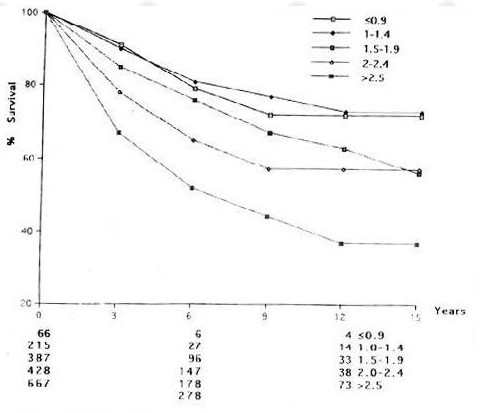
 

Figure 2.4 Survival curves for patients with tubular mixed carcinomas compared with that for patients with ductal NST carcinoma.
Histological Grade

One of the most fundamental aspects of oncological pathology, which has undoubtedly stood the test of time, has been the recognition that the detailed morphological structure of tumours can be correlated with their degree of malignancy. Nearly 70 years ago Greenhough, 53-Greenhough RB. Varying degrees of malignancy in cancer of the breast. J Cancer Res 1925; 9: 452-463. in Boston, USA undertook the first formal study of the grading of histological differentiation in breast cancer. He assessed 8 morphological features in a rather subjective way, but showed a good correlation with so-called 'cure', although the latter was not defined properly. Much credit should also go to Scarff and his colleagues at the Middlesex Hospital in London who re-examined Greenhough's method and decided that only three factors, tubule formation, nuclear pleomorphism and hyperchromatism were of importance. 54-Patey DH, Scarff RW. The position of histology in the prognosis of carcinoma of the breast. Lancet 1928; 1: 801-804. Scarff's method has formed the basis of all subsequent grading systems, whether they use multiple cellular factors 4-Fisher ER, Sass R, Fisher B, et al. Pathologic findings from the National Surgical Adjuvant Project for breast cancer (protocol no 4).  Discrimination for tenth year treatment failure. Cancer 1984; 53: 712-723. // 55-Bloom HJG. Prognosis in carcinoma of the breast. Brit J Cancer 1950a; 4: 259-288. // 56-Bloom HJG. Further studies on prognosis of breast carcinoma. Brit J Cancer 1950b; 4: 347-367. // 57-Bloom HJG, Richardson WW. Histological grading and prognosis in breast cancer.  A study of 1409 cases of which 359 have been followed for 15 years. Brit J Cancer 1957; 11: 359-377. // 58-Contesso G, Mouriesse H, Friedman S, et al. The importance of histologic grade in long-term prognosis of breast cancer: a study of 1010 patients, uniformly treated at the Institut Gustave-Roussy. J Clin Oncol 1987; 5:1378-1386. // 59-Elston CW, Ellis IO. Pathological prognostic factors in breast cancer.  I.  The value of histological grade in breast cancer: experience from a large study with long-term follow-up. Histopathol 1991; 19: 403-410. or nuclear factors. 60-Hartveit F. Prognostic typing in breast cancer. Brit Med J 1971; 4: 253-257. // 61-Black MM, Barclay THC, Hankey BR. Prognosis in breast cancer utilizing histologic characteristics of the primary tumor. Cancer 1975; 36: 2048-2055. // 62-Le Doussal V, Tubiana-Hulin M, Friedman S, et al. Prognostic value of histologic grade nuclear components of Scarff Bloom Richardson (SBR).  An improved score modification based on a multivariate analysis of 1262 invasive ductal breast carcinomas. Cancer 1989; 64: 1914-1921. It is remarkable that given the diversity of methods employed very many studies have demonstrated a significant association between grade and survival indicating the powerful prognostic information provided; this data has been reviewed in some detail previously.25-Elston CW, Ellis IO. The Breast. 3 ed; vol London: Churchill Livingstone, 1998. (Elston CW, Ellis IO, eds. Systemic Pathology.). // 9-Hartman WH. Minimal breast cancer: an update. Cancer 1984; 53: 681-684. // 63-Elston CW. Grading of invasive carcinoma of the breast. In: Page DL, Anderson TJ, eds.  Diagnostic histopathology of the breast. Edinburgh: Churchill Livingstone, 1987: vol, 300-311. // 64-Henson DE, Ries L, Freedman LS, Carriaga M. Relationship among outcome stage of disease and histologic grade for 22,616 cases of breast cancer. Br Cancer Res Treat 1991; 22: 207-219.

Despite this evidence, and the adoption of one of the methods, the so-called Scarff-Bloom-Richardson method by the World Health Organization, 65-Scarff RW, Torloni H. Histological typing of breast tumours.  International histological classification of tumours, no 2. vol Geneva: 1968. (World Health Organization, ed. acceptance of histological grade into routine diagnostic histopathological practice has been slow until relatively recently. In the past this was due in part to lack of clinical demand, as mentioned previously. A further reason for the reluctance to rely on histological grading is the subjective nature of previously published methods and a perceived poor reproducibility and consistency 66-Stenkvist B, Westman-Naeser S, Vegelius J, et al. Analysis of reproducibility of subjective grading systems for breast carcinoma. J Clin Pathol 1979; 32: 929-985. // 67-Gilchrist KW, Kalish L, Gould VE, et al. Interobserver reproducibility of histopathological features in stage II breast cancer.  An ECPG study. Br Cancer Res Treat 1985; 5: 3-10. despite the fact that a substantial number of studies have reported acceptable levels of inter and intra observer variability. 18-Fisher ER, Gregorio RM, Fisher B. The pathology of invasive breast cancer.  A syllabus derived from findings of the National Surgical Adjuvant Breast Cancer Project (protocol no 4). Cancer 1975; 36: 144-156. // 59-Elston CW, Ellis IO. Pathological prognostic factors in breast cancer.  I.  The value of histological grade in breast cancer: experience from a large study with long-term follow-up. Histopathol 1991; 19: 403-410. // 68-Fisher ER, Redmond C, Fisher B. Histologic grading of breast cancer. Pathol Annu 1980; 15: 239-251. // 69-Hopton DS, Thorogood J, Clayden AD, et al. Observer variation in histological grading of breast cancer. Eur J Surg Oncol 1989b; 15: 21-23. // 70-Theissig F, Kunze KD, Haroske G, Meyer W. Histological grading of breast cancer - interobserver reproducibility and prognostic significance. Pathol Res Pract 1990; 186: 732-736.

These conflicting views have highlighted the need for grading to be carried out by trained histopathologists who work to an agreed protocol. Given the nature of the methods, assessment of histological differentiation will always carry an underlying subjective element, but one of the fundamental problems with many of the systems used in previous studies has been the lack of strictly defined written criteria. Bloom and Richardson 57-Bloom HJG, Richardson WW. Histological grading and prognosis in breast cancer.  A study of 1409 cases of which 359 have been followed for 15 years. Brit J Cancer 1957; 11: 359-377. made a useful contribution by adding numerical scoring to the method described by Patey and Scarff 54-Patey DH, Scarff RW. The position of histology in the prognosis of carcinoma of the breast. Lancet 1928; 1: 801-804. but did not provided clear criteria for their cut off points. In Nottingham we have employed further modifications to the above methods in order to introduce greater objectivity. 59-Elston CW, Ellis IO. Pathological prognostic factors in breast cancer.  I.  The value of histological grade in breast cancer: experience from a large study with long-term follow-up. Histopathol 1991; 19: 403-410.

Three characteristics of the tumour are evaluated, tubule formation as an expression of glandular differentiation, nuclear pleomorphism and mitotic counts (Table 2.2).


Table 2.2 Summary of semiquantitative method for assessing histological grade in breast carcinoma.


Feature

Score

Tubule formation

Majority of tumour (>75%)

1

Moderate degree (10-75%)

2

Little or none (<10%)

3

Nuclear pleomorphism

Small, regular uniform cells

1

Moderate increase in size and variability

2

Marked variation

3

Mitotic counts

Dependent on microscope field area

1-3

(see Table 2.3 and Fig. 2.5)

A numerical scoring system on a scale of 1-3 is used to ensure that each factor is assessed individually. In evaluating tubules only structures exhibiting clear central lumina are counted; cut off points of 75% and 10% of tumour area are used to allocate the points. In mucinous carcinoma lumina with tumour cell islands are used as a surrogate for tubules and this also applies to the cribriform structures in invasive cribriform carcinoma. Nuclear pleomorphism is assessed by reference to the regularity of nuclear size and shape of normal epithelial cells in adjacent breast tissue. Increasing irregularity of nuclear outlines and the number and size of nucleoli are useful additional features in allocating points for pleomorphism. The most important modification concerns the evaluation of mitotic figures. Qualitatively care must be taken to count only clearly defined mitotic figures; hyperchromatic and pyknotic nuclei are ignored since they are more likely to represent apoptosis than proliferation. Quantitatively a more accurate assessment is required than designations such as 'about 2 or 3 mitoses per high power field' (HPF) 57-Bloom HJG, Richardson WW. Histological grading and prognosis in breast cancer.  A study of 1409 cases of which 359 have been followed for 15 years. Brit J Cancer 1957; 11: 359-377. since the area of a single HPF may vary by as much as sixfold from one microscope to another. 71-Ellis PSJ, Whitehead R. Mitosis counting - a need for reappraisal. Hum Pathol 1981; 12: 3-4. However, although estimation of mitotic index 72-Quinn CM, Wright NA. The clinical assessment of proliferation and growth in human tumours: evaluation of methods and application as prognostic variables. J Pathol 1990; 160: 93-102. is the most accurate way of counting mitoses it is laborious and unlikely to be of practical use in the routine laboratory. We have, therefore, compromised and standardised mitotic counts to a fixed field area (Table 2.3).


Table 2.3 Assignment of points for mitotic counts according to the field area, using several microscopes.


Microscope

Leitz

Ortholux

Nikon

Labophot

Leitz

Diaplan

Objective

x25

x40

x40

Field diameter (mm)

0.59

0.44

0.63

Field area (mm2)

0.274

0.152

0.312

Mitotic count*

1 point

0-9

0-5

0-11

2 points

10-19

6-10

12-22

3 points

>20

>11

>23

* Assessed as number of mitoses per 10 fields at the tumour periphery.

Using this system any microscope can be calibrated to obtain reproducible and comparable data. Alternatively, mitoses may be assessed using a grid system. 23-National Co-ordinating Group for Breast Screening Pathology. Pathology Reporting in Breast Cancer Screening. 2nd ed ed; vol NHS BSP Publications No 3, 1995. The total number of mitoses per 10 high power fields is counted and the point allocation plotted according to the measured field diameter (Fig 2.5). To our knowledge, in only one other method, that of Contesso et al 58-Contesso G, Mouriesse H, Friedman S, et al. The importance of histologic grade in long-term prognosis of breast cancer: a study of 1010 patients, uniformly treated at the Institut Gustave-Roussy. J Clin Oncol 1987; 5:1378-1386. is reference made to the expression of mitotic counts per defined field area. Unfortunately, their method for counting mitoses is somewhat idiosyncratic and no attempt is made to quantify tubular structures or increase precision in the estimation of pleomorphism.

Overall grade is assigned as follows:


Grade 1 - well differentiated - 3-5 points

Grade 2 - moderately differentiated - 6-7 points

Grade 3 - poorly differentiated - 8-9 points

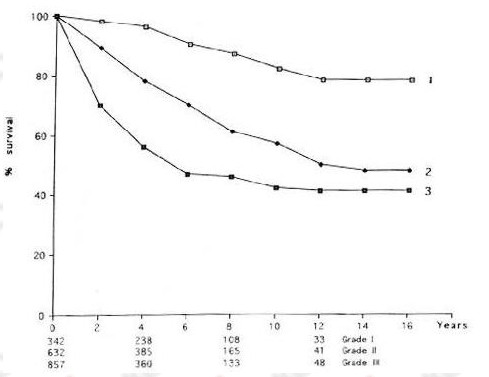
The Nottingham method described above has been fully evaluated in the NTPBCS. The results, based on life table analysis of over 1800 patients followed-up for between 3 and 18 years, confirm conclusively the highly significant relationship between histological grade and prognosis; survival worsens with increasing grade (Fig 2.6). 59-Elston CW, Ellis IO. Pathological prognostic factors in breast cancer.  I.  The value of histological grade in breast cancer: experience from a large study with long-term follow-up. Histopathol 1991; 19: 403-410. The method has now been shown to have good reproducibility in other centres 73-Dalton LW, Page DL, Dupont WD. Histologic grading of breast carcinoma: a reproducibility study. Cancer 1994; 73: 2765-2770. // 74-Frierson HF, Wolber RA, Berean KW, et al. Interobserver reproducibility of the Nottingham modification of the Bloom and Richardson histological grading scheme for infiltrating ductal carcinoma. Am J Clin Pathol 1995; 105: 195-198. // 75-Robbins R, Pinder S, de Klerk N, et al. Histological grading of breast carcinomas.  A study of interobserver agreement. Hum Pathol 1995; 26: 873-879. and it has been adopted for use in the pathological data set of the United Kingdom NHSBSP, 23-National Co-ordinating Group for Breast Screening Pathology. Pathology Reporting in Breast Cancer Screening. 2nd ed ed; vol NHS BSP Publications No 3, 1995. by the European Breast Screening Pathology Group 76-European Commission. European Guidelines for Quality Assurance in Mammography Screening. 2nd ed ed; vol Luxembourg: Office for Official Publications of the European Communities., 1996. (de Wolf CJM, Perry NM, eds. and the Association of Directors of Anatomic and Surgical Pathology in the United States. 77-Connolly JL, Fechner RE, Kempson RL, et al. Recommendations for the reporting of breast carcinoma. Hum Pathol 1996; 27: 220-224.

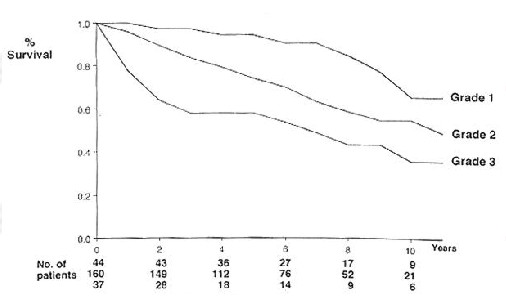
In Nottingham histological grading is carried out in all cases of invasive carcinoma of breast, regardless of morphological type and this view has been accepted by the United Kingdom NHSBSP. 23-National Co-ordinating Group for Breast Screening Pathology. Pathology Reporting in Breast Cancer Screening. 2nd ed ed; vol NHS BSP Publications No 3, 1995. This practice has been criticised by some pathologists who feel that grading is not appropriate for the special histological types such as pure tubular, invasive cribriform, mucinous, medullary and infiltrating lobular carcinomas. However, we have found that when grade is analysed in tumours of particular histological types it is usually found to be appropriate. 78-Pereira H, Pinder SE, Sibbering DM, et al. Pathological prognostic factors in breast cancer.  IV: Should you be a typer or a grader?  A comparative study of two histological prognostic features in operable breast carcinoma. Histopathol 1995; 27: 219-226. For example, most infiltrating lobular carcinomas, especially those of classical subtype, are designated as grade 2 and the overall survival curve of lobular carcinoma overlies that of all other types of grade 2 carcinoma. A minority fall into the grade 1 or grade 3 category and for these cases the survival curves show an appropriate and significant separation (Fig 2.7). Furthermore, we have shown that for some special types such as mucinous and tubular mixed carcinoma, grading provides a more appropriate estimation of prognosis than type alone. 78-Pereira H, Pinder SE, Sibbering DM, et al. Pathological prognostic factors in breast cancer.  IV: Should you be a typer or a grader?  A comparative study of two histological prognostic features in operable breast carcinoma. Histopathol 1995; 27: 219-226.

Histological grade is therefore a very powerful prognostic factor in breast cancer.


Figure 2.5 Graph of mitotic counts by field diameter.
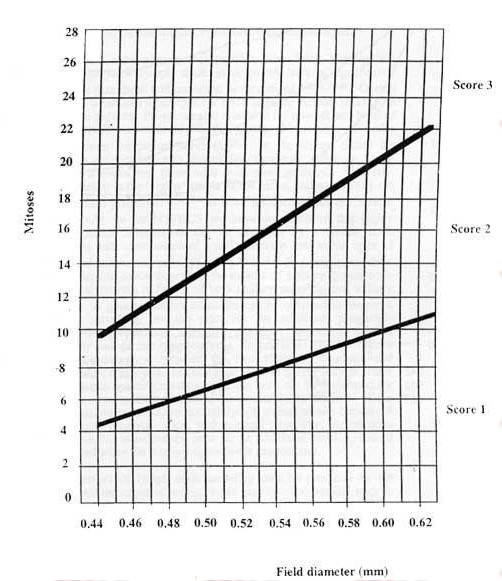
 

Figure 2.6 Relatioship between histological grade and survival in 1830 patients with primary operable carcinoma of breast.
Lymph Node Stage

It has long been recognised that involvement of loco-regional lymph nodes in breast cancer is one of the most important prognostic factors. It is now generally accepted that clinical assessment of lymph node status is not sufficiently accurate for therapeutic use, and that evaluation of lymph node stage should be based on histological examination of excised nodes. 79-Barr LC, Baum M. Time to abandon TNM staging of breast cancer? Lancet 1992; 339: 915-917.

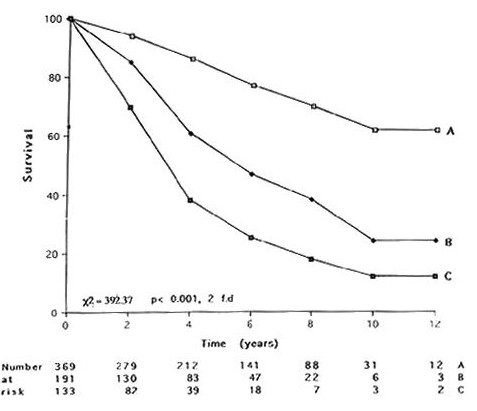
Numerous studies have shown that patients who have histologically confirmed loco-regional lymph node involvement have a significantly poorer prognosis than those without nodal involvement. 1-Galea MH, Blamey RW, Elston CW, et al. The Nottingham Prognostic Index in primary breast cancer. Br Cancer Res Treat 1992; 22: 207-219. // 2-Cutler SJ, Black MM, Mork T, et al. Further observations on prognostic factors in cancer of the female breast. Cancer 1969; 24: 653-657. // 3-Elston CW, Gresham GA, Rao GS, et al. The Cancer Research Campaign (Kings/Cambridge) trial for early breast cancer - pathological aspects. Brit J Cancer 1982; 45: 655-669. // 18-Fisher ER, Gregorio RM, Fisher B. The pathology of invasive breast cancer.  A syllabus derived from findings of the National Surgical Adjuvant Breast Cancer Project (protocol no 4). Cancer 1975; 36: 144-156. // 80-Ferguson DJ, Meier P, Karrison T, et al. Staging of breast cancer and survival rates: an assessment based on 50 years of experience with radical mastectomy. J Am Med Assoc 1982; 248: 1337-1341. // 81-Haybittle JL, Blamey RW, Elston CW, et al. A prognostic index in primary breast cancer. Brit J Cancer 1982; 45: 361-366. // 82-Veronesi U, Galimberti V, Zurrida S, et al. Prognostic significance of number and level of axillary node metastases in breast cancer. Breast 1993; 2: 224-228. Overall 10 year survival is reduced from 75% for node negative patients to 25-30% for node positive patients. Prognosis also related to the number and level of loco-regional lymph nodes involved; the greater the number of nodes involved the poorer the patient survival. 4-Fisher ER, Sass R, Fisher B, et al. Pathologic findings from the National Surgical Adjuvant Project for breast cancer (protocol no 4).  Discrimination for tenth year treatment failure. Cancer 1984; 53: 712-723. //83-Nemoto T, Vana J, Bedwani RN. Management and survival of female breast cancer: results of a national survey by the American College of Surgeons. Cancer 1980; 45: 2917-2924. In the United States the NSABP divides patients into two groups for therapeutic purposes, those with 1-3 positive nodes and those with 4 or more positive. Similarly, involvement ofnodes in the 'higher' levels of the axilla, and specifically the apex, carry a worse prognosis 82-Veronesi U, Galimberti V, Zurrida S, et al. Prognostic significance of number and level of axillary node metastases in breast cancer. Breast 1993; 2: 224-228. // 84-Handley RF. Observations and thoughts on carcinoma of the breast. Proc R Soc Med 1972; 65: 437-444. // 85-Haagensen CD. Diseases of the Breast. vol Philadelphia: Saunders, 1986. (Haagensen CD, ed. as does involvement of the internal mammary nodes. 84-Handley RF. Observations and thoughts on carcinoma of the breast. Proc R Soc Med 1972; 65: 437-444. In the NTPBCS we have demonstrated that highly significant prognostic information can be obtained by a lymph node sampling method with examination of a node from the low axilla, apex of axilla and second intercostal space (Fig 2.8). 81-Haybittle JL, Blamey RW, Elston CW, et al. A prognostic index in primary breast cancer. Brit J Cancer 1982; 45: 361-366. // 86-Blamey RW, Davies CJ, Elston CW, et al. Prognostic factors in breast cancer: the formation of a prognostic index. Clin Oncol 1979; 5: 227-236. // 87-Todd JH, Dowle C, Williams MR, et al. Confirmation of a prognostic index in primary breast cancer. Brit J Cancer 1987; 56: 489-492. // 88-Du Toit RS, Locker AP, Ellis IO, et al. Evaluation of the prognostic value of triple node biopsy in early breast cancer. Br J Surg 1990; 77: 163-167. In recent years there has been considerable debate regarding the extent of axillary lymph node dissection with arguments in favour of both axillary sampling and axillary clearance. 89-Locker AP, Ellis IO, Morgan DAL, et al. Factors influencing local recurrence after excision and radiotherapy for primary breast cancer. Br J Surg 1989; 76: 890-894. // 90-Steele RJC, Forrest APM, Gibson T. The efficacy of lower axillary sampling in obtaining lymph node status in breast cancer: a controlled randomized trial. Br J Surg 1985; 72: 368-369. // 91-Dixon JM, Dillon P, Anderson TJ, Chetty U. Axillary sampling in breast cancer: an assessment of its efficacy. Breast 1998; 7: 206-208. // 92-O'Dwyer PJ. Editorial.  Axillary dissection in primary breast cancer; the benefits of node clearance warrant reappraisal. Br Med J 1992; 302: 360-361. // 93-Cabanes PA, Salmon RJ, Vilcoq JR, et al. Value of axillary dissection in addition to lumpectomy and radiotherapy in early breast cancer. Lancet 1992; 339: 1245-1248. // 94-Kutianawala MA, Sayed M, Stotter A, et al. Staging the axilla in breast cancer: an audit of lymph-node retrieval in one UK regional centre. Eur J Surg Oncol 1998; 24: 280-282. It has been argued that a minimum of 10 nodes should be obtained before deeming a patient node negative 95-Axelsson CK, Mouridsen HT, Zedeler K, et al. Axillary dissection of level I and II lymph nodes is important in breast cancer classification. Eur J Cancer 1992; 28A: 1415-1418. but this is disputed by others. 91-Dixon JM, Dillon P, Anderson TJ, Chetty U. Axillary sampling in breast cancer: an assessment of its efficacy. Breast 1998; 7: 206-208. // 94-Kutianawala MA, Sayed M, Stotter A, et al. Staging the axilla in breast cancer: an audit of lymph-node retrieval in one UK regional centre. Eur J Surg Oncol 1998; 24: 280-282. A greater number of nodes can be obtained at clearance compared with sampling, but the price for the additional prognostic information is the greater post operative morbidity, including reduced shoulder mobility and chronic lymphoedema. In practical terms we believe that a sensible compromise between the two methods, clearance and sampling, should be employed. Internal mammary sampling only provides useful information in medially sited tumours and need not be performed for lateral tumours. Low axillary clearance, carried out below the level of the intercosto-brachial nerve, produces enough lymph nodes (usually between four and 15) for accurate prognostication, with minimal morbidity. Apical node biopsy is additive, but to reduce the need for an additional incision, should only be performed when the primary operation is mastectomy.

A further refinement of lymph node sampling may be provided by the recently developed technique of sentinel node biopsy. The sentinel node is the first lymph node encountered by lymphatics draining from tissues around a tumour. The concept was first introduced in 1977 by Cabanas 96-Cabanas RM. An approach for the treatment of penile carcinoma. Cancer 1977; 39: 456-466. in relation to the lymphatic drainage of penile cancer. The principle of sentinel node biopsy rests on the theory that if metastatic spread has occurred it will first involve the sentinel node and biopsy of this node will be an accurate determinant of stage.


Figure 2.7 Correlation between histological grade and overall survival in 341 patients with infiltrating lobular carcinoma. x² - 21.5, 2 d.f.: p<0.001
Sentinel node biopsy was first introduced clinically in 1992 in cases of malignant melanoma. 97-Morton DL, Wen D-R, Wong JH, et al. Technical details of intraoperative lymphatic mapping for early stage melanoma. Arch Surg 1992; 127: 392-399. Blue dye was injected around the melanoma pre-operatively. At operation the dye was traced to the regional lymph nodes and a 'blue' sentinel node excised. In a large series of patients the sentinel node was identified in 82% and accurate staging was provided in 99% of those in whom it was identified. Lymphoscintigraphic techniques have since been introduced to improve the sentinel node detection rate. This involves the injection of 99m-Tc labelled colloid around the tumour instead of blue dye; portable gamma detecting probes can then be used intra-operatively to detect a specific 'hot' (sentinel) node. This radio-isotope technique was also applied successfully to patients with malignant melanoma. 98-Alex JC, Weaver DL, Fairbank JT, et al. Gamma probe guided lymph node localisation in malignant melanoma. Surg Oncol 1993; 2:303-308. In breast cancer the first reported study used the blue dye method; sentinel nodes were identified in 65% of patients which staged the axilla accurately in 96% of that cohort. 99-Guiliano AE, Kirgan DM, Guenther JM, Morton DL. Lymphatic mapping and sentinel lymphadenectomy for breast cancer. Ann Surg 1994; 220: 391-401. In a subsequent report by the same group it was demonstrated that a learning curve exists for the technique; the detection rate and sensitivity improved in this second series to 93% and 100% respectively. 100-Guiliano AE. Sentinel lymphadenectomy in primary breast carcinoma: an alternative to routine dissection. J Surg Oncol 1996; 62: 75-77. Sentinel node biopsy has now been assessed in numerous studies. Detection rates average 95% and axillary nodal status is predicted accurately in over 95% of these. It appears that detection rates are improved if a combination of blue dye and radiolabelled colloid is used. 101-Albertini JJ, Lyman GH, Cox C, et al. Lymphatic mapping and sentinel node biopsy in the patient with breast cancer. JAMA 1996; 276:1818-1822.

These data suggest that sentinel node biopsy can be used to stage the axilla in primary breast carcinoma. The value of the technique in clinical practice will depend on the false negative rate and the incidence of regional recurrence after sentinel node biopsy alone. Since patients with positive sentinel nodes can be selected for full axillary clearance the clinical utility will also depend on the ability of the technique to determine histological involvement of the node pre, or intra-operatively. 102-Cox CE, Pendas S, Cox JM, et al. Guidelines for sentinel node biopsy and lymphatic mapping of patients with breast cancer. Ann Surg 1998; 277: 645-653. // 103-Veronesi U, Zurrida S, Galimberti V. Consequences of sentinel node in clinical decision making in breast cancer and prospect for future studies. Eur J Surg Oncol 1998; 24: 93-95. // 104-Dixon M. Editorial.  Sentinel node biopsy in breast cancer. B Med J 1998; 317: 295-296. A number of different techniques have been advocated including frozen section, imprint cytology and immunohistochemistry; all are time consuming and labour intensive and their value has yet to be established conclusively 105-Veronesi V, Paganelli G, Viale G, et al. Sentinel lymph node biopsy and axillary dissection in breast cancer: results in a large series. J Natl Cancer Inst 1999; 91: 368-373. // 106-Rubio IT, Korourian S, Cowan C. Sentinel lymph node biopsy for staging breast cancer. Am J Surg 1998; 176: 532-535. // 107-van Diest PJ, Torrenga H, Borgstein PJ, et al. Reliability of intraoperative frozen section and imprint cytological investigation of sentinel lymph nodes in breast cancer. Histopathol 1999; 35: 14-18. Prospective clinical trials, which are required to address these issues, are currently being planned. For a fuller account of the pathological aspects of sentinel node biopsy the reader is referred to recent review article by Anderson (1999) and Lee et al (2000). 108-Anderson TJ. The challenge of sentinel node biopsy. Histopathol 1999; 35: 82-84. // 109-Lee AHS, Ellis IO, Pinder SE, et al. Pathological assessment of sentinel lymph node biopsies in patients with breast cancer. Virchows Arch (A) Pathol Anat 2000 (in press);

The significance of the presence of metastatic carcinoma in the adipose tissue surrounding axillary lymph nodes, the so-called extranodal spread or extracapsular metastasis (ECM), is uncertain with conflicting data. It was suggested by Mambo and Gallager, 110-Mambo NC, Gallager HS. Carcinoma of the breast.  The prognostic significance of extrandoal extension of axillary disease. Cancer 1977; 39: 2280-2285. in a retrospective analysis, that this feature conveyed a poor prognosis in patients with up to three nodes involved, but not in those with four or more nodes involved. Similar results were obtained by Cascinelli et al 111-Cascinelli N, Greco M, Bufalino R, et al. Prognosis of breast cancer with axillary node metastases after surgical treatment only. Eur J Cancer Clin Oncol 1987; 23: 795-799. in a study of mastectomy without adjuvant radiotherapy or chemotherapy except


Figure 2.8 Relationship between lymph node stage (A - no node involvement, B - low node involvement, C - high node involvement) and survival in 693 patients with primary operable carcinoma of the breast.
that the effect of extranodal spread on recurrence rate was seen in patients with two or more nodes affected, irrespective of the number of nodes involved. Fisher et al 112-Fisher ER, Gregorio RM, Redmond C, et al. Pathologic findings from the National Surgical Adjuvant Breast Project (protocol no 4).  III.  The significance of extranodal extension of axillary metastases. Am J Clin Pathol 1976; 65: 439-444. have demonstrated in a prospective study that extranodal spread occurs significantly more frequently in patients who have four or more nodes involved by metastatic tumour, and although such patients were more likely to suffer short term relapse they could not demonstrate that this effect was independent of nodal status. This view supports that of Hartveit 113-Hartveit F. Paranodal tumour in breast cancer: extranodal extension versus vascular spread. J Pathol 1984; 144: 253-256. who found that extranodal spread had no intrinsic prognostic significance and concluded that the presence of tumour cells in efferent vessels was the only indicator of poorer prognosis in patients with involved nodes. More recently Donegan and colleagues 114-Donegan WL, Stine SB, Samter TG. Implications of extracapsular nodal metastates for treatment and prognosis of breast cancer. Cancer 1993; 72: 778-782. have confirmed the association between ECM and the number of nodes involved, but found that there was no significant influence on prognosis. They concluded that ECM was not an indicator per se for irradiation after complete axillary clearance.

There has also been debate on the actual size of lymph node metastases, and in particular the question of so-called occult metastases. Several studies have shown that the presence of 'micrometastases' measuring 2 mm or less does not affect survival adversely, compared with that of node negative patients. 115-Fisher ER, Palekar A, Rockette H, et al. Pathologic findings from the National Surgical Adjuvant Breast Project (protocol no 4).  V.  Significance of axillary nodal micro and macro metastases. Cancer 1978a; 42: 2032-2038. // 116-Nasser IA, Lee AKC, Bosari S, et al. Occult axillary lymph node metastates in 'node-negative' breast carcinoma. Hum Pathol 1993; 24: 950-957. // 117-Rosen PP, Beattie EJ, Saigo PE, et al. Occult axillary lymph node metastases from breast cancers with intramammary lymphatic tumor emboli. Am J Surg Pathol 1982; 6: 639-641. The data concerning the detection of tiny deposits, often single cells, by serial sectioning or immunostaining is conflicting. Some groups have found a significantly worse prognosis for such patients, 118-Trojani M, de Mascarel I, Coindre JM, Bonichon F. Micrometastases to axillary lymph nodes from invasive lobular carcinoma of breast: detection by immunohistochemistry and prognostic significance. Br J Cancer 1987; 56: 838-839. // 119-Wells CA, Heryet A, Brochier J, et al. The immunohistochemical detection of axillary micrometastases in breast cancer. Br J Cancer 1984; 50: 193-197. // 120-Springall RJ, Rytina ERC, Millis RR. Incidence and signficance of micrometastases in axillary lymph nodes detected by immunohistochemical techniques. J Pathol 1990; 160: 174A. // 121-International Breast Cancer Study Group. Prognostic importance of occult axillary lymph node micrometastases from breast cancers. Lancet 1990; 335: 1565-1568. // 122-Cote RJ, Peterson HF, Chaiwan. Role of immunohistochemical detection of lymph-node metastases in management of breast cancer. Lancet 1999; 354: 896-900. whilst others could detect no difference in survival. 115-Fisher ER, Palekar A, Rockette H, et al. Pathologic findings from the National Surgical Adjuvant Breast Project (protocol no 4).  V.  Significance of axillary nodal micro and macro metastases. Cancer 1978a; 42: 2032-2038. // 116-Nasser IA, Lee AKC, Bosari S, et al. Occult axillary lymph node metastates in 'node-negative' breast carcinoma. Hum Pathol 1993; 24: 950-957. // 123-Galea MH, Athanassiou E, Bell J, et al. Occult regional lymph node metastases from breast carcinoma: immunohistological detection with antibodies CAM 5.2 and NCRC-11. J Pathol 1991; 165: 221-227. // 124-McGuckin MA, Cummings MC, Walsh MD, et al. Occult axillary node metastases in breast cancer: their detection and prognostic significance. Br J Cancer 1996; 73: 88-95. Hartveit and Lilleng 125-Hartveit F, Lilleng PK. Breast cancer: two micrometastatic variants in the axilla that differ in prognosis. Histopathol 1996; 28:241-246. have suggested that the site of the deposits is the most important factor; in their study survival of patients with subcapsular deposits was the same as that of node negative patients, but deposits within the lymphoid tissue conveyed the sample prognosis as node positive patients. Further studies are clearly required.

In routine practice it is inappropriate to examine serial sections in every case because of the workload implications, and a sensible compromise is necessary. If nodes are obviously involved on gross examination a single confirmatory section is sufficient. Nodes measuring less than 5 mm in length may be processed in groups and need only be cut at two levels. Nodes greater than 5 mm in length should be sliced at intervals at right angles to the long axis, multiple blocks up to 4 in number being taken according to the overall node size. Immunostaining should be reserved for the small number of cases in which the morphological appearances are suspicious, but not diagnostic of metastatic carcinoma.

Vascular Invasion

The prognostic value of the estimation of vascular invasion in breast cancer is disputed. 126-Lee AKC, De Lellis RA, Silverman ML, et al. Lymphatic and blood vessel invasion in breast carcinoma; a useful prognostic indicator? Hum Pathol 1986a; 17: 984-987. // 127-Lee AKC, De Lellis RA, Wolfe HJ. Intramammary lymphatic invasion in breast carcinomas.  Evaluation using ABH isoantigens as endothelial markers. Am J Surg Pathol 1986b; 10: 589-594. Some studies have found no significant correlation with clinical outcome 36-Dawson PJ, Ferguson DJ, Karrison T. The pathologic findings of breast cancer in patients surviving 25 years after radical mastectomy. Cancer 1982; 50: 2131-2138. // 128-Sears HF, Janus C, Levy W, et al. Breast cancer without axillary metastases.  Are there subpopulations? Cancer 1982; 50: 1820-1827. whilst others have shown that the presence of vascular invasion predicts for both recurrence 89-Locker AP, Ellis IO, Morgan DAL, et al. Factors influencing local recurrence after excision and radiotherapy for primary breast cancer. Br J Surg 1989; 76: 890-894. // 129-Roses DF, Bell DA, Fotte TJ, et al. Pathologic predictors of recurrence in stage 1 (T1N0M0 and T2N0M0) breast cancer. Am J Clin Pathol 1982; 78: 817-820. // 130-Bettelheim R, Mitchell D, Gusterson BA. Immunocytochemistry in the identification of vascular invasion in breast cancer. J Clin Pathol 1984b; 37: 364-366. and long term survival. 131-Nime FA, Rosen PP, Thaler HT, et al. Prognostic significance of tumour emboli in intramammary lymphatics in patients with mammary carcinoma. Am J Surg Pathol 1977; 1: 25-30. // 132-Nealon TF, Nkongho A, Grossi CE, et al. Treatment of early cancer of the breast (T1N0M0 and T2N0M0) on the basis of histological characteristics. Surgery 1981; 89: 279-289. // 133-Rosen PP. Tumor emboli in intramammary lymphatics in breast carcinoma: Pathological criteria for diagnosis and clinical significance. Pathol Annu 1983; 18: 215-232. // 134-Dawson PJ, Karrison T, Ferguson DJ. Histological features associated with long-term survival in breast cancer. Hum Pathol 1986; 17: 1015-1021. // 135-Pinder S, Ellis IO, O'Rourke S, et al. Pathological prognostic factors in breast cancer.  III.  Vascular invasion: relationship with recurrence and survival in a large series with long-term follow-up. Histopathol 1994; 24: 41-47. One explanation for such discrepancies may be the wide variation in the reported frequency of vascular invasion (20-54%) and the related problem of the distinction of true vessels, especially lymphatics, from artefactual soft tissue spaces.

Although muscular blood vessels are occasionally involved, tumour emboli are usually identified within thin walled vascular channels. It is impossible to determine whether such spaces are lymphatics, capillaries or venules and for this reason we believe that vascular permeation should be left unspecified and the broad term 'vascular invasion' used. In order to avoid overdiagnosis care must be taken to avoid misinterpretation of both ductal carcinoma in situ and shrinkage artefact associated with cords of invasive tumour as vessel invasion. 135-Pinder S, Ellis IO, O'Rourke S, et al. Pathological prognostic factors in breast cancer.  III.  Vascular invasion: relationship with recurrence and survival in a large series with long-term follow-up. Histopathol 1994; 24: 41-47. // 136-Örbo A, Stalsberg H, Kunde D. Topographic criteria in the diagnosis of tumor emboli in intramammary lymphatics. Cancer 1990; 66: 972-977. These problems are greatly reduced by good fixation, as emphasised in the section on specimen preparation earlier, and by working to a simple but strict protocol. Vascular invasion should only be assessed in the breast tissue surrounding tumour and not within it. Tumour emboli must be present within spaces having a complete lining of endothelial cells; these spaces are often in close proximity to small muscular blood vessels and may by separated from the main tumour by normal lobular units, topographical patterns emphasised by Orbo et al (Fig 2.10). 136-Örbo A, Stalsberg H, Kunde D. Topographic criteria in the diagnosis of tumor emboli in intramammary lymphatics. Cancer 1990; 66: 972-977. Immunostaining for endothelial markers such as laminin, type IV collagen, Factor VIII related antigen and Ulex Europeus agglutinin I is not helpful in distinguishing vessels from duct structures, but may be useful in excluding shrinkage artefact. 126-Lee AKC, De Lellis RA, Silverman ML, et al. Lymphatic and blood vessel invasion in breast carcinoma; a useful prognostic indicator? Hum Pathol 1986a; 17: 984-987. // 127-Lee AKC, De Lellis RA, Wolfe HJ. Intramammary lymphatic invasion in breast carcinomas.  Evaluation using ABH isoantigens as endothelial markers. Am J Surg Pathol 1986b; 10: 589-594. // 137-Bettelheim R, Penman HG, Thornton-Jones H, et al. Prognostic significance of peritumoral vascular invasion in breast cancer. Br J Cancer 1984a; 50: 771-777. // 138-Martin SA, Perez-Reyes N, Mendelsohn G. Angioinvasion in breast carcinoma; an immunohistochemical study of factor VIII-related antigen. Cancer 1987; 59: 1918-1922. // 139-Ordonez NG, Brooks T, Thompson S, et al. Use of Ulex europeus agglutinin I in the identification of lymphatic and blood vessel invasion in previously stained microscopic slides. Am J Surg Pathol 1987; 11: 543-550. // 140-Saigo PE, Rosen PP. The application of immunohistochemical stains to identify endothelial-lined channels in mammary carcinoma. Cancer 1987; 59: 51-54. In routine practice their use should be confined to the resolution of equivocal cases. Reproducibility of the evaluation of vascular invasion has been shown to be satisfactory, 4-Fisher ER, Sass R, Fisher B, et al. Pathologic findings from the National Surgical Adjuvant Project for breast cancer (protocol no 4).  Discrimination for tenth year treatment failure. Cancer 1984; 53: 712-723. // 117-Rosen PP, Beattie EJ, Saigo PE, et al. Occult axillary lymph node metastases from breast cancers with intramammary lymphatic tumor emboli. Am J Surg Pathol 1982; 6: 639-641. // 135-Pinder S, Ellis IO, O'Rourke S, et al. Pathological prognostic factors in breast cancer.  III.  Vascular invasion: relationship with recurrence and survival in a large series with long-term follow-up. Histopathol 1994; 24: 41-47. and even when this was questioned complete agreement was obtained in over 85% of cases. 141-Gilchrist KW, Gould VE, Hirschl S, et al. Interobserver variation in the identification of breast carcinoma in intramammary lymphatics. Hum Pathol 1982; 13: 170-172.

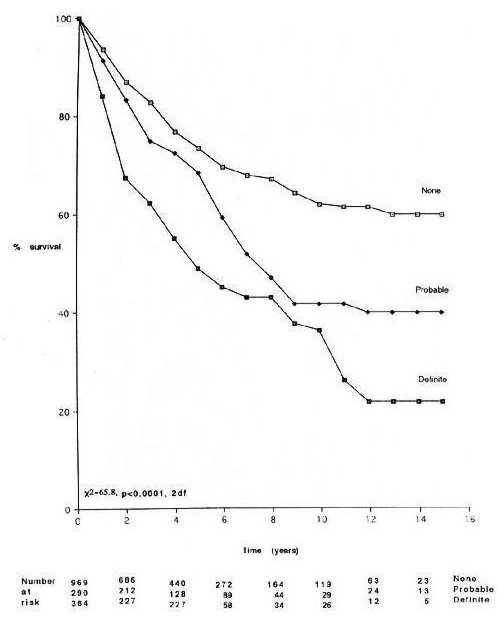
Vascular invasion correlates very closely with loco-regional lymph node involvement, 133-Rosen PP. Tumor emboli in intramammary lymphatics in breast carcinoma: Pathological criteria for diagnosis and clinical significance. Pathol Annu 1983; 18: 215-232. // 135-Pinder S, Ellis IO, O'Rourke S, et al. Pathological prognostic factors in breast cancer.  III.  Vascular invasion: relationship with recurrence and survival in a large series with long-term follow-up. Histopathol 1994; 24: 41-47. // 136-Örbo A, Stalsberg H, Kunde D. Topographic criteria in the diagnosis of tumor emboli in intramammary lymphatics. Cancer 1990; 66: 972-977. // 142-Davis BW, Gelber R, Goldhirsh A, et al. Prognostic significance of peritumoral vessel invasion in clinical trials of adjuvant therapy for breast cancer with axillary node metastases. Hum Pathol 1985; 16: 1212-1218. and possibly because of this association it has been claimed that it can provide prognostic information as powerful as lymph node stage. 130-Bettelheim R, Mitchell D, Gusterson BA. Immunocytochemistry in the identification of vascular invasion in breast cancer. J Clin Pathol 1984b; 37: 364-366. There is certainly a correlation between the presence of vascular invasion and early recurrence in lymph node negative patients 129-Roses DF, Bell DA, Fotte TJ, et al. Pathologic predictors of recurrence in stage 1 (T1N0M0 and T2N0M0) breast cancer. Am J Clin Pathol 1982; 78: 817-820. // 130-Bettelheim R, Mitchell D, Gusterson BA. Immunocytochemistry in the identification of vascular invasion in breast cancer. J Clin Pathol 1984b; 37: 364-366. // 143-Rosen PP, Saigo PE, Brown DW, et al. Predictors of recurrence in stage 1 (T1N0MO) breast carcinoma. Ann Surg 1981; 193: 15-25. and Roses et al 129-Roses DF, Bell DA, Fotte TJ, et al. Pathologic predictors of recurrence in stage 1 (T1N0M0 and T2N0M0) breast cancer. Am J Clin Pathol 1982; 78: 817-820. have shown that the adverse prognostic effects are also independent of occult axillary node involvement. In the NTPBCS we have confirmed the prognostic value of vascular invasion in relation to long term survival (Fig 2.11) but, like Roses et al, 129-Roses DF, Bell DA, Fotte TJ, et al. Pathologic predictors of recurrence in stage 1 (T1N0M0 and T2N0M0) breast cancer. Am J Clin Pathol 1982; 78: 817-820. we have also demonstrated that this effect is independent of lymph node stage, using multivariate analysis. 135-Pinder S, Ellis IO, O'Rourke S, et al. Pathological prognostic factors in breast cancer.  III.  Vascular invasion: relationship with recurrence and survival in a large series with long-term follow-up. Histopathol 1994; 24: 41-47. However, at the present time it appears that the most important application for the assessment of vascular invasion lies in its power as a predictor of local recurrence following conservation therapy. 89-Locker AP, Ellis IO, Morgan DAL, et al. Factors influencing local recurrence after excision and radiotherapy for primary breast cancer. Br J Surg 1989; 76: 890-894. // 129-Roses DF, Bell DA, Fotte TJ, et al. Pathologic predictors of recurrence in stage 1 (T1N0M0 and T2N0M0) breast cancer. Am J Clin Pathol 1982; 78: 817-820. // 135-Pinder S, Ellis IO, O'Rourke S, et al. Pathological prognostic factors in breast cancer.  III.  Vascular invasion: relationship with recurrence and survival in a large series with long-term follow-up. Histopathol 1994; 24: 41-47. // 144-Rosen PP. The pathology of invasive breast carcinoma. In: Harris JR, Hellman S, Henderson IC, Kinne DW, eds.  Breast Diseases. 2nd ed. Philadelphia: Lippincott, 1991: vol, 245-296. VI also predicts significantly for the risk of flap recurrence after mastectomy. 145-O'Rourke S, Galea MH, Euhus D, et al. An audit of local recurrence after simple mastectomy. Br J Surg 1994; 81: 386-389.
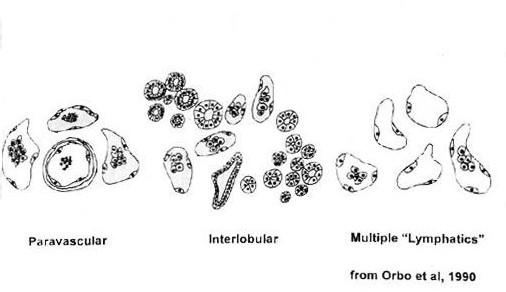


Figure 2.11 Relationship between vascular invasion and survival in 1623 patients with primary operable carcinoma of the breast.
Miscellaneous Factors

A number of other morphological features of breast carcinoma have been proposed as prognostic factors, but are of relatively less importance than those discussed above.

There is no doubt that angiogenesis is an important factor in the growth and metastatic potential of carcinomas. 146-Folkman J. What is the evidence that tumors are angiogenesis dependent? J Natl Cancer Inst 1990; 82: 4-6. // 147-Ellis LM, Fidler IJ. Angiogenesis and breast cancer metastasis. Lancet 1995; 346: 388-389. It has therefore been suggested that tumours showing a high level of new vessel formation would have a poorer prognosis than those with relatively little angiogenesis. This association appears to have been demonstrated for a number of tumours including breast carcinoma. 148-Weidner N, Semple JP, Welch WR, Folkman J. Tumour angiogenesis and metastasis - correlation in invasive breast carcinoma. New Eng J Med 1991; 324: 1-8. // 149-Weidner N, Folkman J, Pozza F, et al. Tumour angiogenesis: a new significant and independent prognostic indicator in early stage breast cancer. J Natl Cancer Inst 1992; 84: 1875-1887. // 150-Toi M, Kashitani J, Tominaga T. Tumour angiogenesis is an independent prognostic indicator in primary breast carcinoma. Int J Cancer 1993; 55: 371-374. // 151-Horak ER, Leek R, Klenk N, et al. Angiogenesis, assessed by platelet/endothelial cell adhesion molecule antibodies, as an indicator of node metastases and survival in breast cancer. Lancet 1992; 340: 1120-1124. // 152-Bosari S, Lee AK, De Lellis RA, et al. Microvessel quantitation and prognosis in invasive breast carcinoma. Hum Pathol 1992; 23: 755-761. However, other studies have failed to identify such an association 153-Hall NR, Fish DE, Hunt N, et al. Is the relationship between angiogenesis and metastasis in breast cancer real? Surg. Oncol. 1992; 1: 223-229. // 154-Cohen P, Guidi A, Harris J, Schnitt S. Microvessel density and local recurrence in patients with early stage breast cancer treated by wide excision alone (WEA). Modern Pathol 1994; 7: 14A (abstr). // 155-Sightler HE, Borrowsky AD, Dupont WD, et al. Evaluation of tumour angiogenesis as a prognostic marker in breast cancer. Modern Pathol 1994; 7: 22A (abstr). // 156-Van Hoef MEHM, Knox WF, Dhesi SS. Assessment of tumour vascularity as a prognostic factor in lymph node negative invasive breast cancer. Eur J Cancer 1993; 29A: 1141-1145. and our own experience is similar to this second group of investigators. 157-Goulding H. Assessment of angiogenesis in breast cancer. An important factor in prognosis? Hum Pathol 1995; 26: 1196-1200. We have assessed vascular density in breast carcinomas using both random field selection and pre-selection of the perceived area of highest vascularity, the so-called 'hot spot' using immunostaining for expression of two endothelial markers, CD 34 and CD 31. Weidner 148-Weidner N, Semple JP, Welch WR, Folkman J. Tumour angiogenesis and metastasis - correlation in invasive breast carcinoma. New Eng J Med 1991; 324: 1-8. // 149-Weidner N, Folkman J, Pozza F, et al. Tumour angiogenesis: a new significant and independent prognostic indicator in early stage breast cancer. J Natl Cancer Inst 1992; 84: 1875-1887. has commented that others have not used his precise technique which involves use of the antibody to factor VIII and analysis of the 'hot spot' regions. These techniques were used by Costello and colleagues, 158-Costello P, McCann A, Carney DN, et al. Prognostic significance of microvessel density in lymph node negative breast carcinoma. Hum Pathol 1995; 26: 1181-1184. but they were unable to demonstrate any relationship between vessel density and clinical outcome. From these latter studies it appears that there are major difficulties in reproducibility of the measurement of new vessel formation in breast carcinomas and it is our view that the performance of vascular counts on routinely selected blocks of tumour tissue offers no advantage over the traditional pathological prognostic factors.

Tumour necrosis is a relatively common phenomenon, occasionally visible macroscopically as a sharply demarcated area of dullness, usually in a central position. Microscopically necrotic tumour is characterised, as in any tissue, by the nuclear changes of karyorrhexis, pyknosis and karyolysis, with a change to granular eosinophilic cytoplasmic degeneration. When tumour necrosis has been present for a sufficient length of time it may be accompanied by replacement fibrosis. Necrosis is almost entirely confined to ductal NST carcinomas and appears to occur most frequently in those of high grade. 159-Page DL, Anderson TJ. Diagnostic Histopathology of the Breast. vol Edinburgh: Churchill Livingstone, 1987. // 160-Carter D, Elkins RC, Pipkin RD, et al. Relationship of necrosis and tumour border to lymph node metastases and 10 year survival in carcinoma of the breast. Am J Surg Pathol 1978; 2: 39-46. // 161-Fisher ER, Palekar AS, Gregorio RM, et al. Pathologic findings from the National Surgical Adjuvant Project for breast cancers (protocol no 4).  IV.  Significance of tumour necrosis. Hum Pathol 1978b; 9: 523-530. The prognostic value of tumour necrosis has been evaluated in several studies and its presence has been equated with decreased survival and early treatment failure. 160-Carter D, Elkins RC, Pipkin RD, et al. Relationship of necrosis and tumour border to lymph node metastases and 10 year survival in carcinoma of the breast. Am J Surg Pathol 1978; 2: 39-46. // 161-Fisher ER, Palekar AS, Gregorio RM, et al. Pathologic findings from the National Surgical Adjuvant Project for breast cancers (protocol no 4).  IV.  Significance of tumour necrosis. Hum Pathol 1978b; 9: 523-530.162-Parham DM, Hagen N, Brown RA. Morphometric analysis of breast carcinoma: association with survival. J Clin Pathol 1988; 41: 173-177. // 163-Gilchrist KW, Gray R, Fowble B, et al. Tumor necrosis is a prognostic predictor for early recurrence and death in lymph node-positive breast cancer: a 10 year follow-up study of 728 Eastern Cooperative Oncology Group patients. J Clin Oncol 1993; 11: 1929-1935. Unfortunately, in none of these studies is a precise definition given of terms used, such as 'extensive' necrosis, which limits their value. Parham and colleagues have proposed a new 'simplified' method for grading breast cancer by combining tumour necrosis and mitotic counts. 164-Parham DM, Hagen N, Brown RA. Simplified method of grading primary carcinomas of the breast. J Clin Pathol 1992; 45: 517-520. In summary there is some published evidence which suggests that the presence of tumour necrosis may be a poor prognostic feature. However, before tumour necrosis is accepted as a useful prognostic factor reproducible criteria for the definition of necrosis and evaluation of its extent must be devised. Tumour necrosis must also be tested in multivariate analysis against other prognostic factors, especially histological grade with which it appears to be closely associated.

Stromal fibrosis is found frequently in invasive carcinoma of the breast, but in varying amounts. 162-Parham DM, Hagen N, Brown RA. Morphometric analysis of breast carcinoma: association with survival. J Clin Pathol 1988; 41: 173-177. // 165-Underwood JCE. A morphometric analysis of human breast carcinoma. Br J Cancer 1972; 26: 234-237. The prognostic significance is uncertain, and stromal fibrosis has been associated with a favourable prognosis, 166-Sistrunk WE, MacCarty WC. Life expectancy following radical amputation for carcinoma of the breast - a clinical and pathological study of 218 cases. Ann Surg 1922; 75: 61-69. poorer survival 162-Parham DM, Hagen N, Brown RA. Morphometric analysis of breast carcinoma: association with survival. J Clin Pathol 1988; 41: 173-177. // 167-Black R, Prescott R, Bers K, et al. Tumour cellularity, oestrogen receptors and prognosis in breast cancer. Clin Oncol 1983; 9: 311-318. and to have no effect on survival. 36-Dawson PJ, Ferguson DJ, Karrison T. The pathologic findings of breast cancer in patients surviving 25 years after radical mastectomy. Cancer 1982; 50: 2131-2138. In this respect tumour type is a confounding factor, since extensive fibrosis may be found both in low grade tumours such as tubular carcinomas and in high grade ductal NST carcinomas. For this reason it is unlikely that stromal fibrosis will provide useful prognostic information.

Stromal elastosis is also a feature of many breast carcinomas, distributed either in a periductal or a diffuse pattern. 168-Parfrey NA, Doyle CT. Elastosis in benign and malignant breast disease. Hum Pathol 1985; 16: 674-676. As with stromal fibrosis there are conflicting data on the prognostic significance of elastosis. Some studies have suggested that its presence is associated with a good prognosis 169-Shivas AA, Douglas JG. The prognostic significance of elastosis in breast carcinoma. J Roy Coll Surg Edinb 1972; 17: 315-320. // 170-Masters JR, Millis RR, King RJB, Rubens RD. Elastosis and response to endocrine therapy in human breast cancer. Br J Cancer 1979; 39: 536-539. but this has not been confirmed by others. 171-Robertson AJ, Brown RA, Cree IA. Prognostic value of measurement of elastosis in breast carcinoma. J Clin Pathol 1981; 34: 738-743. // 172-Rasmussen BB, Pedersen BV, Thorpe SM. Elastosis in relation to prognosis in primary breast cancer. Cancer Res 1985; 45: 1428. Giri et al 173-Giri DD, Lonsdale RN, Dangerfield VJM, et al. Clinicopathological significance of intratumoral variations in elastosis grades and the oestrogen receptor status of human breast caricnomas. J Pathol 1987; 151: 297-303. found that central elastosis had greater clinical significance, but this was based on a small study with only short-term follow-up. Elastosis is particularly associated with tumours having a relatively good prognosis (eg tubular, tubular mixed, invasive cribriform); 22-Ellis IO, Galea M, Broughton N, et al. Pathological prognostic factors in breast cancer. II.  Histological type.  Relationship with survival in a large study with long-term follow-up. Histopathol 1992; 20: 479-489. this suggests that stromal elastosis is not an independent prognostic factor.

The amount of ductal carcinoma in situ (DCIS) associated with invasive carcinomas of the breast is extremely variable, and the assessment of its extent is highly subjective. Some groups have suggested that the presence of prominent DCIS within invasive carcinomas conveys a better prognosis and a decreased frequency of nodal metastases. 174-Matsukuma A, Enjoji M, Toyoshima S. Ductal carcinoma of the breast.  An analysis of the proportion of intraductal and invasive components. Pathol Res Prac 1991; 187: 62-67. // 175-Silverberg SG, Chitale AR. Assessment of the significance of the proportion of intraductal and infiltrating tumor growth in ductal carcinoma of the breast. Cancer 1973; 32: 830-837. However, it has been suggested that the DCIS component in invasive carcinomas may be of greater importance in the management of patients considered for conservation therapy. At an EORTC meeting in 1989 it was concluded that 'the principal risk factor for breast relapse after breast conserving treatment is large residual burden and the main source of this burden is an extensive in situ component (EIC)'. 176-van Dongen JA, Fentiman IS, Harris JR, et al. In-situ breast cancer: the EORTC consensus meeting. Lancet 1989;2:25-27. This statement was based on data from a number of studies 177-Schnitt SJ, Connelly JL, Harris JR, et al. Pathologic predictors of early local recurrence in stage I and stage II breast cancer treated by primary radiation therapy. Cancer 1984; 53: 1049-1057. // 178-Fourquet A, Campana F, Zafrani B, et al. Prognostic factors of breast recurrence in the conservative management of early breast cancer: a 25 year follow-up. Int J Rad Oncol Biol Physiol 1989; 17: 719-725. // 179-Holland R, Connelly JL, Gelman R, et al. The presence of an extensive intraduct component following a limited excision correlates with prominent residual disease in the remainder of the breast. J Clin Oncol 1990; 8: 113-118. // 180-Jacquemier J, Kurtz JM, Amalric R, et al. An assessment of extensive intraductal component as a risk factor for local recurrence after breast-conserving therapy. Br J Cancer 1990; 61: 873-876. but a subsequent publication from the Boston group has cast some doubt on its validity. 181-Gage I, Schnitt SJ, Nixon AJ, et al. Pathologic margin involvement and the risk of recurrence in patients treated with breast-conserving therapy. Cancer 1996; 78: 1921-1928. They found that assessment of excision margins was by far the most powerful factor influencing local recurrence rates and that EIC was not a predictive factor if complete excision was obtained. EIC did, however, predict for the likelihood that margins would be involved and it therefore has some value in this respect.

.
   © SEAP. Sociedad Española de Anatomía Patológica

Actualizado: 25/10/2001